
AI and Prior Authorization in Orthopedics: What the Data Actually Shows
AI and Prior Authorization in Orthopedics: What the Data Actually Shows
Most orthopedic practices are familiar with the promise: automation vendors say they can handle the majority of prior authorization submissions through payer APIs, leaving staff to manage only the exceptions. The appeal is clear, especially in orthopedics, where a single total joint case can involve imaging, implant documentation, facility authorization, DME, and the surgical request itself. The idea of faster, more efficient processing is understandably attractive.
The problem is that submission speed and approval outcomes are two different things, and orthopedic PA data makes that gap hard to miss.
Submission Was Never the Bottleneck
Most prior authorization volume has already been digital for years. Portal-based submission has been the norm across specialties, orthopedics included, well before generative AI entered the conversation. So when a vendor promises to "automate 90% of submissions," the honest question is: 90% of what, exactly? Usually, it means 90% of the cases that were eligible for an API pathway in the first place, not 90% of the practice's total PA burden, and not the cases most likely to get denied.
That distinction matters more in orthopedics than in almost any other specialty, because so much of the volume, joint replacements, spine procedures, injections, DME, sits in categories where payer criteria are detailed and reviewed against clinical documentation, not just eligibility flags.
Take a total joint case as an example. Payers often use criteria sets like InterQual, which require documentation of conservative treatment, imaging that supports the diagnosis, and a clear statement of functional impact before surgery is authorized. An eligibility check only confirms that the plan covers the procedure. It does not address whether the chart documents six weeks of failed physical therapy, whether the imaging supports advanced osteoarthritis, or whether the note links the diagnosis to a specific functional limitation. These are the details payer reviewers look for, and an API cannot assess them.
DME brings its own set of requirements. Braces, CPM units, and other post-op equipment usually need a Certificate of Medical Necessity or a Detailed Written Order, linked to a face-to-face encounter within a specific timeframe and a clear explanation of how the device supports the patient's condition. These are documentation and workflow issues, not submission-speed problems, and they can be overlooked when the focus is only on fast submission.
In all these cases, payers are applying clinical criteria, not just administrative checks. Submission tools can confirm a request was sent, but they cannot ensure the supporting record will meet the review standard.
Where the Real Growth Is Happening
Within DataMatrix’s orthopedic clients, total prior authorization volume increased 49% from 2023 to 2025. During that same period, denial and peer-to-peer caseloads rose by 307%, and online denials alone jumped 623%. If electronic submission were truly solving the prior authorization problem, we would expect those numbers to move in the opposite direction. That has not been the case.
Orthopedic practices see this every day. A total knee or hip case may show 'no authorization required' in the payer portal, but medical necessity documentation is still reviewed later. Spine referrals may have conservative care dates logged, but not connected to functional impact. DME orders for post-op braces or CPM units can miss the face-to-face requirement on the qualifying visit. These are not submission issues. They are documentation and clinical judgment challenges, and APIs cannot address them.
What's Actually Driving Denials
If digital submission were truly addressing prior authorization challenges, we would see more cases moving smoothly through the portal and fewer ending up in denial or appeal.
Of the 1000’s of cases that DataMatrix reviewed, denials trace to one of three root causes:
-
Client-side documentation deficiencies.
-
Member plan limitations.
-
Non-preferred medications.
This clearly indicates that submission speed and approval outcomes are separate issues. Moving cases faster from EHR to payer portal does not change what the payer’s clinical reviewer needs to see. It simply means more cases arrive sooner, but many still do not pass review.
For an orthopedic practice, this shows up in familiar places. A total knee or hip case where the payer's portal returns "no authorization required" for the CPT code, so the case looks clear at submission, but that response only confirms no pre-service review is required for that code, member, and date of service. It says nothing about whether the medical necessity documentation on file will hold up if the case is pulled for post-payment review.
A payer like UHC, for example, may route hip cases against InterQual criteria that expect x-ray imaging as the primary supporting study for advanced osteoarthritis, not necessarily MRI, and a chart built around the wrong imaging type can still be vulnerable even with a clean "no auth required" response in hand.
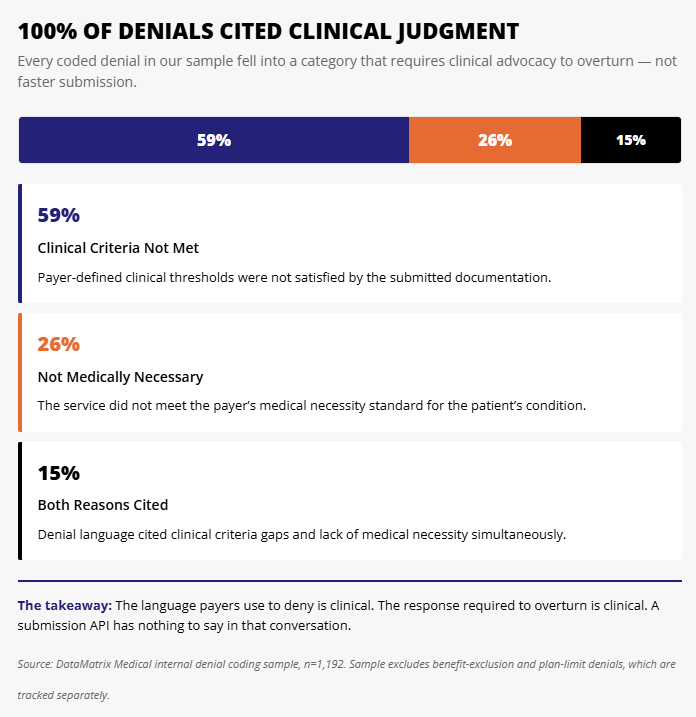
These are not submission problems. They are documentation and clinical judgment issues. Submission tools can confirm a request was sent, but they cannot tell a practice whether the supporting record will pass review without further attention.
What This Means for Practice Operations
None of this makes AI submission tools useless. They're genuinely effective at what they do, moving clean, well-documented cases through faster than a person keying in the same fields. The issue is scope. Submission automation addresses the easiest part of the prior authorization workflow while leaving the harder, growing part, denials, appeals, and peer-to-peer, exactly where it was.
For practice leaders evaluating any AI PA tool, three questions tend to cut through the pitch quickly:
-
Is that automation rate measured against total PA volume, or only against the subset of cases eligible for the API pathway?
-
What happens to a case once it's denied or flagged for retroactive review? Where does that work go?
-
What share of your practice's denials trace to documentation omissions, benefit limits, or non-preferred devices? Those are the cases no submission layer can resolve on its own.
Orthopedic prior authorization isn't getting simpler because more of it is digital. It's getting more clinically detailed, and that's where practice time and expertise still matter most.
For those who want a deeper look at how to structure and staff a prior authorization workflow, DataMatrix Medical's Guide to Prior Authorization Outsourcing covers the operational side in more detail.
Author: DataMatrix Medical