
Why Some Doctors Are Recommended by AI (And Others Aren't)
Why Some Doctors Are Recommended by AI (And Others Aren't)
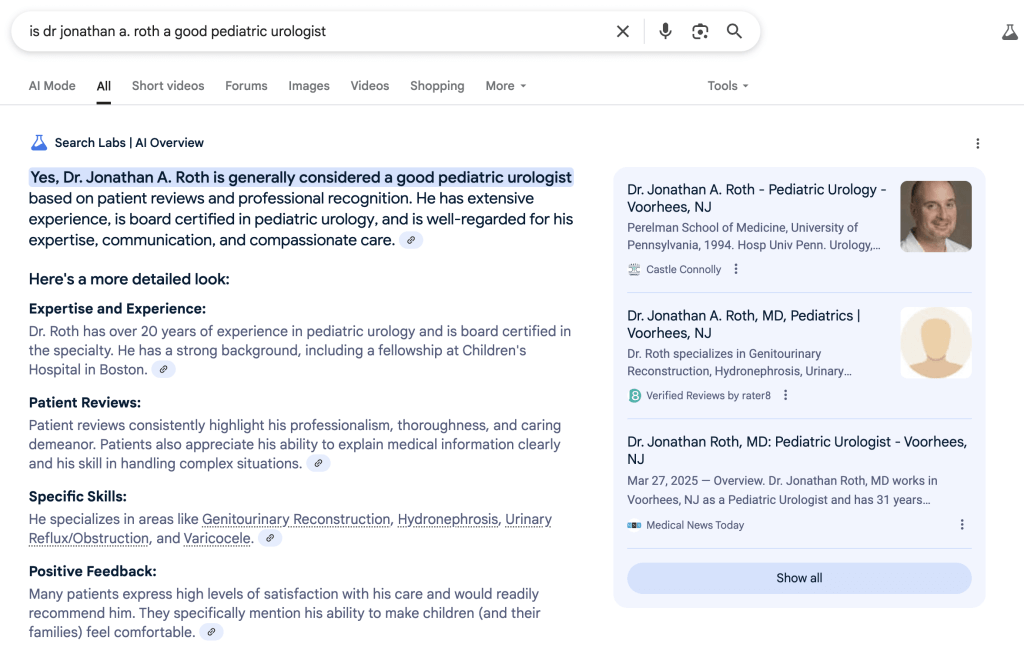
The way patients search for care is evolving — fast. Instead of clicking through websites or asking friends for recommendations, many are turning to AI-powered tools like Google’s AI Overviews, ChatGPT, Bing Copilot, and even voice assistants for answers.
This shift means we need a new way of thinking about online visibility. Instead of just optimizing for search engines, we now need to optimize for these AI-powered assistants. The goal is simple: make it incredibly easy for these AI tools to find, understand, and trust your practice's information, so they recommend you to patients. This is called generative engine optimization (GEO).
These tools don’t just skim your website. They analyze data across the web — online reviews, business listings, third-party directories — and pull their answers from the most credible, structured sources they can find.
Why Featuring Reviews on Your Website Matters
According to rater8’s latest survey findings, 52% of patients trust AI-generated search results as much or more than standard Google search results when choosing a doctor. And what do they want most in those AI-powered answers? Reviews. For healthcare practices, this change makes the way you collect and display patient feedback more important than ever.
It's no longer enough to just collect reviews on Google, Healthgrades, or other third-party sites. To earn visibility in AI search, your patient feedback needs to live on your own website in a format that AI can easily interpret and trust. That means featuring reviews, testimonials, FAQs, and provider-specific feedback alongside details like star ratings, visit dates, provider names, and relevant keywords such as “urgent care” or “shoulder pain.”
By showcasing this type of content directly on your website, you’re not just telling patients why they should choose you, you’re giving AI the clear, structured signals it needs to recommend your practice with confidence.
Put simply: the more organized and visible your reviews are, the more likely AI is to put your practice front and center.
How Does AI Know Which Doctors to Recommend?
With the online search journey shorter than ever, patients want quick, trustworthy answers, especially when they’re choosing a doctor. AI tools are stepping in to provide those answers. To do that, they prioritize information that’s clear, current, and consistent across the web.
That means:
-
Accurate provider details
-
Verified locations and specialties
-
Consistent star ratings
-
Keyword-rich patient feedback
-
Structured review data that’s easy to interpret
If your reviews are scattered, outdated, or lacking detail, AI might overlook your practice, even if you’re delivering top-tier care.
How to Make Patient Reviews on Your Website Easy for AI to Read and Trust
AI loves it when content on your website content follows a clear, predictable structure. Think consistent formatting and helpful context like star ratings, provider names, visit dates, and relevant terms such as “urgent care” or “shoulder pain.” This approach is often referred to as structured data — a way of presenting information so AI can read it without confusion.
Essentially it’s not just about what the patient said, it’s about how that information is presented. Organized online reviews with consistent metadata help AI connect the dots between the feedback, the provider, and the services offered.
Think of it this way: structured feedback is like a neatly labeled file folder. Unstructured feedback is more like a messy stack of papers — and AI trusts the file folder.
In healthcare, trust is everything. Google understands this, which is why it holds all medical information to its highest standard of accuracy. It needs proof that you are who you say you are. This is where something called schema markup comes in.
Think of it like a set of digital highlighters for your website.
Without it, an AI sees a review that says “5 stars for Dr. Evans!” and has to guess: “Which Dr. Evans? At which clinic? For what specialty?”
With schema markup, you're digitally highlighting the information for the AI. You're telling it: 'This 5-star rating is for Dr. Mary Evans, MD, who is a Cardiologist at our 123 Main Street clinic.'
This 'highlighted' data is clear, organized, and easy for AI to trust. It's no longer a messy stack of papers; it's a perfectly organized file. A great online review becomes a powerful, searchable fact that AI can confidently use to recommend your practice.
Where you're embedding testimonials and reviews in your website, 'highlighting' every review with this schema markup would be a time-consuming technical job. You'll want to talk to your web designer about how you can do this efficiently for some of your content.
Thankfully, rater8 customers' review tools have all of this technology built-in with our Verified Reviews listings and testimonials widgets. Every patient review we push to your website widgets is automatically organized and formatted in the exact way AI tools like to see it, with no coding or extra work required from your team. You can focus on patient care while we ensure your online visibility is future-proof.
What You Can Do Right Now to Improve Your AI Visibility
Here are a few practical steps you can take to ensure your practice is future-proofed with the rise in AI search:
-
Do an 'Online Consistency' Check: Make sure your clinic's name, address, phone number, and doctor specialties are exactly the same everywhere online (your website, Google, Healthgrades, etc.). Why? AI rewards consistency because it signals trustworthiness.
-
Ask for Detailed Reviews: Gently prompt patients to mention the reason for their visit or the doctor they saw. Why? A review that says, "Dr. Patel was great for my knee replacement," directly answers a future patient's AI search for "best doctor for knee replacement near me."
-
Keep the Reviews Coming: A steady stream of recent reviews is crucial. Why? It tells AI that your practice is active, relevant, and currently trusted by patients.
-
Automate the Technical Stuff: Use a platform like rater8 to automatically format every review for AI. Why? It saves you the headache of managing the technical details and ensures you're getting maximum visibility from every piece of patient feedback.
Bottom Line: Be the Clear Choice for Patients (and AI)
We’re in the middle of a fundamental shift in how patients search for care, and the practices that will succeed are the ones that make it easy for AI to find and trust them. By presenting clean, consistent, and current patient feedback, you are far more likely to be recommended by AI search tools. This doesn't just put you at the top of the list—it sends a clear signal to every potential patient that you are the obvious choice for their care.